
For years, landlords have been told to watch for obvious red flags on rental applications: missing information, questionable references, inconsistent employment history, or income that doesn’t appear sufficient to cover the rent.
In 2026, the bigger problem may be an application that looks too perfect.
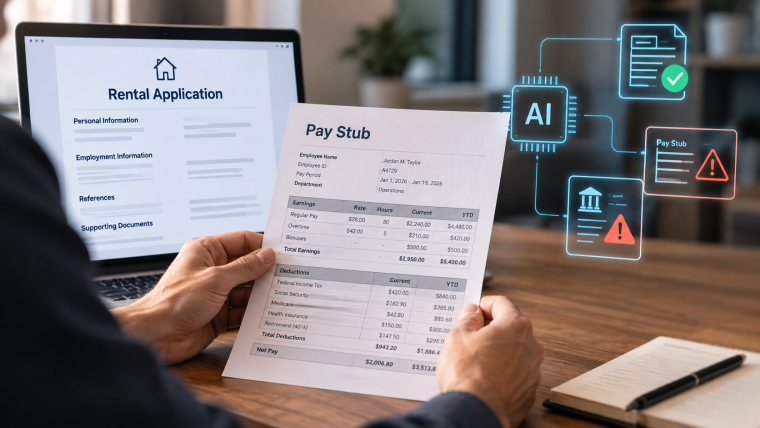
Artificial intelligence and increasingly accessible document-editing tools have made it easier to create convincing pay stubs, employment records, bank statements, and other documents used during the rental process. At the same time, synthetic identity fraud can combine real and fabricated personal information to create applicants who may survive a basic review.
For rental property owners, that changes the tenant-screening question. It’s no longer enough to ask whether an applicant appears qualified. Landlords also need confidence that the information they’re evaluating is authentic.
Rental application fraud isn’t new. Applicants have long been able to exaggerate income, provide misleading references, or alter documents. What has changed is the quality and accessibility of the tools available to do it.
TransUnion reported in 2026 that AI-generated documentation and synthetic identity techniques are making fabricated applicant information increasingly difficult to distinguish from legitimate information. Income and employment verification are particularly vulnerable because convincing pay stubs, bank statements, and employment records can now be created with relatively little effort.
That matters because traditional tenant screening often assumes the underlying information is genuine. A credit check can tell a landlord quite a bit about the person attached to a Social Security number, for example, but it doesn’t necessarily prove that every document accompanying the application is legitimate.
The result is an important distinction between screening information and verifying it.
Imagine receiving an application from someone who appears to be an ideal tenant. The applicant earns well above the property’s income requirement, has provided recent pay stubs, and has submitted a bank statement showing regular deposits.
A few years ago, those documents might have carried significant weight on their own. Today, landlords should be more cautious about treating uploaded documents as independent proof.
Verification can include checking information against sources that are harder for an applicant to manipulate. Depending on the screening process, that might mean verifying employment independently, connecting directly to payroll or financial-account data, or comparing information across multiple sources rather than relying on a single uploaded document.
At Green Residential, our tenant screening process reflects that shift. In addition to traditional background screening, the company uses digital identity fraud mitigation and digital bank account analytics to help verify the person and financial information behind an application.
The goal isn’t to assume every applicant is dishonest. It’s to avoid making a major financial decision based solely on information that hasn’t been independently verified.
Income isn’t the only information landlords need to verify. Synthetic identity fraud can involve combining legitimate personal information with invented details to create an identity that appears real enough to pass surface-level checks. Stolen identities create another risk: the person submitting an application may not actually be the person whose information appears on it.
That makes identity verification an increasingly important first step. A screening report is only useful if the landlord has confidence that it belongs to the person who is actually applying to occupy the property.
Landlords should also pay attention to inconsistencies across an application. Addresses, employment dates, identification, income records, and credit information should tell a coherent story. A discrepancy doesn’t automatically indicate fraud, but it can be a reason to verify information before making a decision.
The rise of AI-generated documents doesn’t mean credit reports, rental history, background checks, and landlord references have stopped being useful. They remain important parts of evaluating an applicant.
The difference is that landlords increasingly need two layers of screening: first verifying that the applicant and supporting information are legitimate, and then evaluating whether that verified applicant meets the property’s rental criteria.
We previously outlined what the tenant screening process entails, including reviewing employment, income, credit, rental history, and other information. Those fundamentals still apply. What’s changing is how carefully the information feeding that process may need to be authenticated.
That distinction matters because sophisticated fraud can make a weak applicant look unusually strong. If the income figure isn’t real, calculating whether it satisfies an income requirement doesn’t tell you much.
Fraud prevention shouldn’t lead landlords to make up new requirements whenever an application makes them uncomfortable. A sound screening process should use clear criteria and apply them consistently.
That means deciding in advance what documentation and verification will be required, rather than subjecting some applicants to extra scrutiny based on instinct or assumptions. Landlords also need to comply with applicable fair housing and consumer reporting requirements when screening prospective tenants.
A standardized process is useful for another reason: it makes anomalies easier to spot. When every applicant moves through the same verification steps, unusual information stands out without requiring the landlord to rely solely on intuition.
For property owners managing their own rentals, this is also a good time to review an older screening process. A checklist built around “collect a pay stub, run a credit report, call the employer” may no longer provide the same level of confidence it once did.
AI hasn’t made rental applications inherently untrustworthy. It has made appearances less useful as proof.
A polished application, professional-looking pay stub, or clean bank statement can still be completely legitimate. The difference in 2026 is that landlords have fewer reasons to assume a document is genuine simply because it looks genuine.
The strongest screening processes therefore don’t depend on spotting a fake by eye. They verify identity, income, employment, rental history, and financial information through multiple sources before a lease is signed.
For an individual landlord, building and maintaining that kind of screening process can quickly become another full-time responsibility. At Green Residential, we help Texas rental property owners handle tenant screening along with leasing, rent collection, maintenance, inspections, and the other day-to-day demands of managing an investment property.
If you’d rather spend your time owning your rental property than verifying every application that comes through the door, contact us to learn how our property management and tenant-screening services can help protect your investment.








TREC Broker License # 9001367


 CALL US